What the Swarm Knows
On beekeeping, Marcus Aurelius, and the most powerful AI model most organizations will never touch. They are the same story.
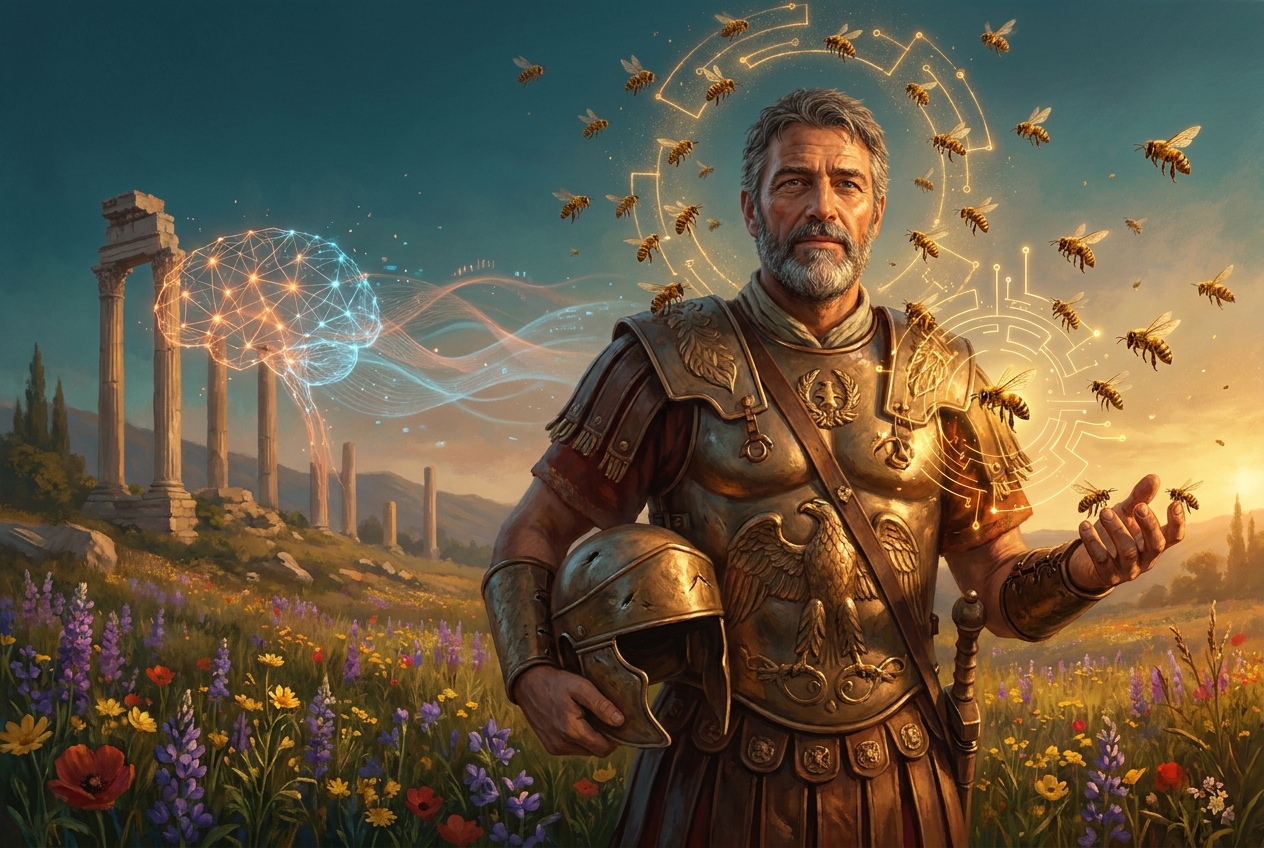
Late April at the Hive
There is a moment in late April when a beehive becomes almost impossible to manage and almost impossible to stop watching at the same time.
The frames are dense. The queen is laying up to two thousand eggs a day. New bees are chewing through their capped cells and emerging every few minutes, glistening, disoriented, immediately useful. At the same time, the winter bees — the ones who kept the colony alive through January on stored fat and nervous energy — are dying. They lived six months, an eternity for a honeybee. Their replacements will live six weeks.
The colony is simultaneously shrinking and exploding. It is the most dynamic biological system I have ever stood next to, and I keep bees specifically for moments like this.
What threatens a healthy spring hive is not disease or cold or predators. What threatens it is success. If the colony grows faster than the beekeeper adds space and structure, the workers sense the overcrowding and begin preparing to swarm. They raise a new queen. When she’s ready, the old queen takes roughly half the forager workforce and leaves — permanently. The swarm departs to find a new home, often in someone’s eave or a hollow oak. The original hive is left with half the population it had at the exact moment the nectar flow begins.
The beekeeper who wasn’t paying attention loses half their hive at the worst possible moment.
The job, I’ve learned, is not to control the bees. It is to give them enough room and enough structure to do what they were built to do.
Marcus Aurelius Got There First
Marcus Aurelius kept no bees, as far as I know. But in the Meditations — that private notebook of a Roman emperor reminding himself how to govern, daily — he wrote something that stopped me cold the first time I read it while sitting next to my hives.
“That which is not good for the swarm is not good for the bee.”
— Marcus Aurelius, Meditations 6.54
Six words with no loose threads. The individual and the collective are not in tension — they are expressions of the same thing. What is built only for the individual bee, at the expense of the hive, destroys both. The swarm is not a constraint on the bee. The swarm is the condition that makes the bee possible.
It is the cleanest articulation of systems thinking I have encountered in any literature, ancient or modern. And it turns out to be exactly the right frame for what is happening in artificial intelligence right now.
The Hive Is Splitting
Three weeks ago, Anthropic unveiled Claude Mythos through a controlled-access program called Project Glasswing. If you have not heard of it, that is by design.
Approximately fifty organizations currently have access: AWS, Google, Microsoft, Apple, Cisco, CrowdStrike, JPMorganChase. The model is not available for purchase. There is no waitlist in the ordinary sense. Access has been extended to a small group of vetted entities and, as of this writing, the White House is negotiating over whether that circle should expand to one hundred twenty organizations — partly over concerns about compute scarcity, partly over national security implications still being worked out.
Here is what the model can do, stated plainly for anyone who advises or leads a company.
Claude Mythos found zero-day vulnerabilities — previously unknown security holes — in every major operating system and browser it examined. It then wrote a four-step exploit chain using those vulnerabilities. It succeeded on seventy-three percent of expert-level cybersecurity challenges. It completed a thirty-two step simulated corporate network attack, end to end, without human assistance.
| Signal | Figure |
|---|---|
| Expert cybersecurity challenges solved | 73% |
| Vulnerabilities found still unpatched | >99% |
| Organizations with access — worldwide | ~50 |
More consequentially: over ninety-nine percent of the vulnerabilities it identified remain unpatched. The standard ninety-day disclosure window that the security industry uses to coordinate between researchers and vendors may not be sufficient for organizations running legacy infrastructure. Most large enterprises in regulated industries — CPG, healthcare, financial services — are running systems that were never designed to be patched on a ninety-day cycle.
The federal picture is its own kind of swarm in motion. The Pentagon classified Anthropic as a national security supply chain risk. The NSA is using the model anyway. The White House wants access and is pushing back on the rollout timeline. The most powerful security tool in the history of computing is being rationed, and the organizations that do not have it cannot fully audit their own exposure against an adversary that might.
If you are not one of the fifty, you have no timeline. You are flying at your current altitude while the threat landscape is being rescanned at a resolution you cannot access.
This is not alarmism. It is the situation. The hive is splitting, and this swarm is not controlled.
The Forager’s Equation
A forager bee will fly approximately five hundred miles over its six-week life. It will visit two million flowers. Its total lifetime contribution to the honey supply is one-twelfth of a teaspoon.
Then it dies, and the next bee picks up exactly where it left off.
The bee does not calculate whether the fraction of a teaspoon is worth the five hundred miles. It flies because flying is what it is. The meaning is not in the output. The meaning is in the doing.
BCG’s 2026 research estimates that fifty to fifty-five percent of U.S. jobs will be significantly reshaped by AI within two to three years. Anthropic’s own usage data shows that fifty-two percent of Claude interactions are augmentation — a human and the model working together — and forty-five percent are automation, the model working alone.
Watch which direction that ratio moves. That is the question of the decade.
“If the exponential continues… it cannot possibly be more than a few years before AI is better than humans at essentially everything.”
— Dario Amodei, CEO, Anthropic, 2026
What I find myself sitting with — at the hives, early on a Saturday morning, before the bees have fully started their day — is not the productivity question. I am relatively confident we will figure out the productivity question. It is the meaning question.
The forager bee does not wonder whether its one-twelfth teaspoon matters. The doing and the meaning are the same thing. Humans have always derived a significant part of our sense of purpose from the work itself — not just the output, but the effort, the skill, the showing up. What changes when the output is no longer ours to claim? What changes when the flying is optional?
I do not have a clean answer. I am not sure anyone does yet. But I think the people who hold that question seriously — who sit with it rather than wave it off — will make better decisions about how to deploy these systems inside their organizations.
What I Take From This
The beekeeper’s lesson is not a metaphor I wear lightly. I have made the mistake of not adding a box in time. I watched a swarm leave. Half the hive, gone, at exactly the wrong moment.
The lesson is not that growth is dangerous. The lesson is that growth without structure fails itself.
The organizations that will navigate the next three years well are not the ones that move the fastest or the ones that hold back longest. They are the ones building the right room — the governance frameworks, the human-AI working protocols, the institutional judgment about which decisions stay with people and which ones can safely move to machines. They are adding the box before the colony decides for itself.
Aurelius was right. What is not good for the swarm is not good for the bee. The technology does not exempt us from this. If anything, it makes the old insight more urgent.
I am back at the hives this weekend. I need to check whether there are swarm cells forming. The work is never done, and that is the part I find I mean when I say I love it.
— Ian
AI CoE Lead, Altria | Board Chair, rvatech | iantyndall.com